
 EN
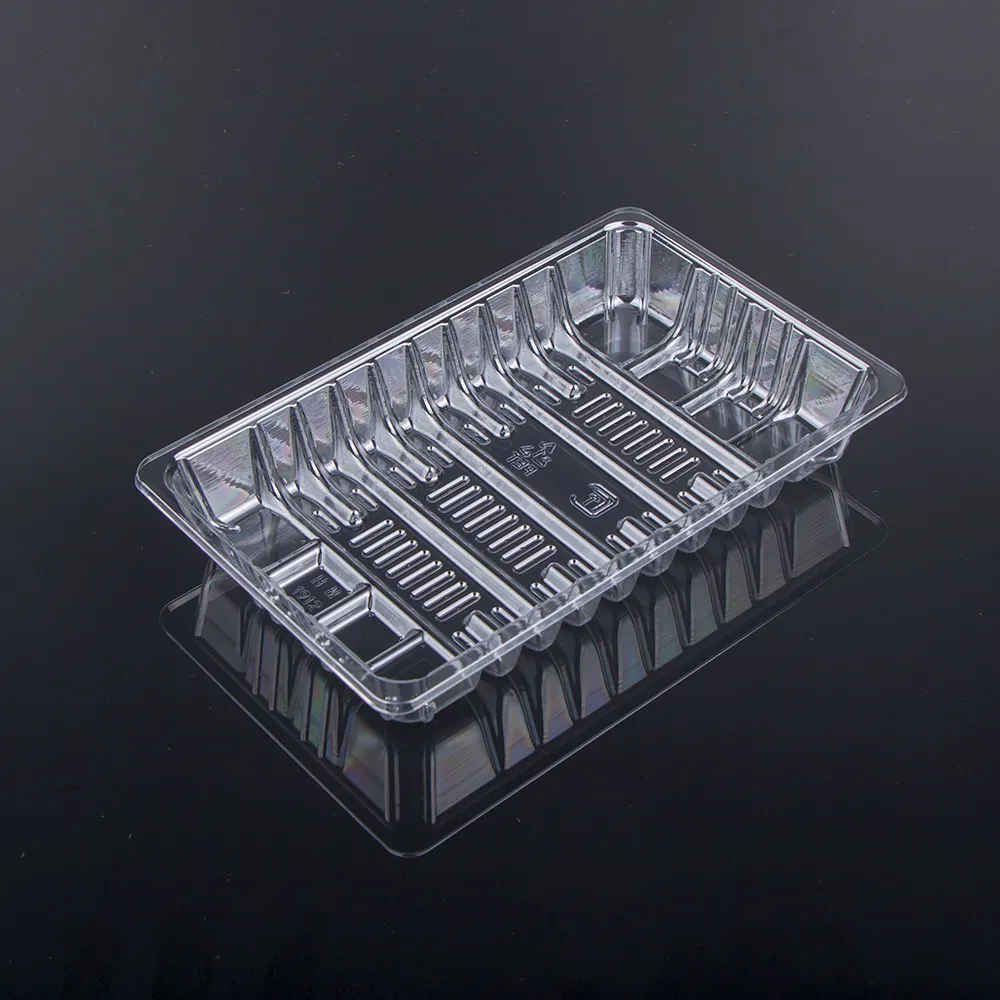
Superior Barrier Protection Against Moisture, Oxygen, and Microbial Contamination
Low MVTR and OTR: How APET trays outperform PP and PS in preserving freshness and preventing oxidation
APET (amorphous polyethylene terephthalate) trays deliver a dual barrier—low moisture vapor transmission rate (MVTR) and very low oxygen transmission rate (OTR)—that jointly slows moisture loss and oxidative spoilage. In standard film equivalents, APET exhibits an OTR of 2–4 cc/m²/day and an MVTR of 1.5–2.5 g/m²/day (Plastics Technology 2023). By comparison, PP shows an OTR of 50–100 cc/m²/day and PS reaches 80–150 cc/m²/day—orders of magnitude higher. While PP offers lower MVTR (0.3–0.5 g/m²/day), its poor oxygen barrier fails to prevent lipid oxidation, color fade, or flavor degradation. PS provides weaker resistance to both moisture and oxygen. As a result, APET excels where both dryness and oxidation control matter—especially for cheese, fresh pasta, baked goods, and ready meals. Its low OTR helps preserve vitamin C, natural pigments, and volatile flavor compounds; its low MVTR maintains texture integrity and inhibits surface microbial growth. Together, these properties extend shelf life with reduced reliance on preservatives.
| Polymer | Typical OTR (cc/m²/day) | Typical MVTR (g/m²/day) |
|---|---|---|
| APET | 2–4 | 1.5–2.5 |
| PP | 50–100 | 0.3–0.5 |
| PS | 80–150 | 1.5–3.0 |
Non-porous surface integrity: Inhibiting bacterial adhesion, ingress, and biofilm formation on PET tray container surfaces
APET forms a smooth, non-porous surface after thermoforming—free of the microscopic pits and fissures common in expanded PS or uncoated PP. Bacteria adhere less readily to such hydrophobic, low-roughness surfaces; studies show APET trays with average surface roughness below 0.1 µm reduce bacterial adhesion by up to 90% compared with rougher PS (Food Packaging Forum 2022). The continuous polymer matrix also blocks capillary absorption of purge, dairy fluids, or condensation—eliminating subsurface pathways for contamination and depriving biofilms of the moisture and shelter they require. This structural integrity ensures cleaning and sanitation agents contact all surfaces uniformly, with no residue traps. In high-humidity cold chains, it supports sustained hygienic performance—lowering initial microbial load and reducing cross-contamination risk during filling, sealing, and retail handling.
Regulatory-Compliant Chemical Inertness for Direct Food Contact
FDA 21 CFR 177.1630 and EU Regulation (EU) No 10/2011: Compliance validation for virgin PET tray container
FDA 21 CFR 177.1630 (2024) establishes the U.S. regulatory baseline for virgin PET tray containers used in direct food contact. It permits PET only when composition and extractable yields meet strict limits—including a maximum extractable fraction of 0.5 mg per square inch under water, heptane, and 8% ethanol exposure. In parallel, EU Regulation (EU) No 10/2011 (consolidated 2024) mandates that all monomers and additives appear on the Union List and that overall migration from the finished tray does not exceed 10 mg/dm². Specific migration limits apply—for example, antimony (a residual PET catalyst) is capped at 0.04 mg/kg of food simulant. Validation therefore combines resin supplier declarations, infrared spectroscopy, and final-article migration testing—ensuring chemical inertness and safety across North American and European markets.
Migration testing essentials: Simulants, time/temperature protocols, and specific migration limit (SML) adherence for PET tray container
Migration testing uses food simulants and time/temperature protocols calibrated to real-world use conditions. Aqueous foods are modeled with 10% ethanol, acidic foods with 3% acetic acid, and fatty foods with vegetable oil or 95% ethanol (EU 10/2011, 2024). For chilled applications, long-term contact may be simulated with 10 days at 40°C; hot-fill or microwaveable formats typically require 2 hours at 70°C. The overall migration limit remains 10 mg/dm², while specific migration limits apply to key monomers—e.g., ethylene glycol (30 mg/kg) and terephthalic acid (7.5 mg/kg)—in the appropriate simulant. Crucially, testing is performed on final trays, not raw resin, to confirm that lidding films, inks, or labels do not compromise compliance.
Hygienic Design and Operational Safety in High-Speed Food Production
Smooth, non-porous geometry enabling CIP/SIP compatibility and residue-free sanitation in RTE and fresh-cut packaging lines
The smooth, non-porous geometry of APET trays eliminates crevices, gaps, and sharp corners where food residues and moisture can accumulate—supporting effective clean-in-place (CIP) and sterilization-in-place (SIP) protocols. Uniform fluid flow across product-contact surfaces ensures repeatable, residue-free sanitation—reducing manual intervention, shortening downtime, and lowering bacterial adhesion risk. This is especially critical for high-risk ready-to-eat (RTE) and fresh-cut products like salads, cut fruit, and chilled meals. Engineered APET surfaces withstand repeated high-temperature wash cycles without abrasion, particle shedding, or dimensional distortion. Integrated draining and drying features further minimize condensation buildup—a key concern in chilled and modified-atmosphere operations. These design traits align with FDA and EHEDG hygienic design principles, and routine CIP/SIP validation confirms full coverage of detergents, rinse water, and sterilants—sustaining operational safety at high throughput.
PET Tray Container Integration in Advanced Packaging Systems: Aseptic and MAP
Pre-sterilized PET tray container performance in aseptic fill environments: ISO 11137 dose mapping and FDA process validation benchmarks
Pre-sterilized APET trays maintain sterility, clarity, dimensional stability, and low extractables through validated irradiation—making them ideal for aseptic filling of dairy, beverages, and high-acid products. ISO 11137 dose mapping identifies minimum and maximum dose zones within each tray load, ensuring all food-contact surfaces receive the sterilizing dose required for a sterility assurance level (SAL) of 10⁻⁶. Unlike many polyolefins, APET’s stable amorphous structure resists yellowing and embrittlement at typical e-beam or gamma doses (15–45 kGy). FDA process validation adds rigor: installation qualification (IQ), operational qualification (OQ), and performance qualification (PQ) must include biological indicator results, bioburden data, and dose audit reports before commercial release—guaranteeing sterile entry into the aseptic filler.
MAP synergy: Dimensional stability and lidding seal integrity for gas-tight enclosure and extended shelf life of chilled and microwaveable meals
In modified atmosphere packaging (MAP), APET trays must retain flange flatness and body rigidity throughout gas flushing, lidding, and cold-chain distribution. APET’s low creep and high dimensional stability ensure consistent seal geometry—preventing microleaks that compromise headspace gas integrity and accelerate spoilage. For chilled ready meals, the tray delivers impact resistance at refrigeration temperatures; for microwaveable formats, it retains thermal stability to avoid warping or seal failure during reheating. Seal integrity is verified via peel strength, burst pressure, and dye penetration tests—scaled to tray size and lid material. Precision-engineered sidewall ribbing and flat flange geometry support uniform sealing force, improving repeatability on high-speed lines and protecting meals from oxygen ingress—extending shelf life by days to weeks, depending on formulation and storage conditions.
FAQ
What are the main advantages of APET trays over PP and PS trays?
APET trays provide superior barrier protection against both moisture and oxygen, making them highly effective at preserving freshness, maintaining texture, and extending shelf life. They also offer better dimensional stability, hygienic surface integrity, and regulatory compliance.
How does APET reduce bacterial contamination?
APET trays feature a smooth, non-porous surface that reduces bacterial adhesion by up to 90%. This prevents contamination pathways and makes cleaning more effective, thus improving hygiene in food packaging systems.
What regulatory standards do APET trays meet for food contact?
APET trays comply with FDA 21 CFR 177.1630 and EU Regulation (EU) No 10/2011, which set strict limits on extractables and migration for materials used in direct food contact. Migration testing ensures adherence to these standards.
Can APET trays be used in MAP and aseptic systems?
Yes, APET trays are compatible with both MAP and aseptic systems. Their low creep, dimensional stability, and sterility capabilities make them ideal for gas-tight enclosures and aseptic filling environments.
How do APET trays support CIP/SIP cleaning protocols?
APET trays possess smooth, non-porous geometries that enable effective clean-in-place (CIP) and sterilization-in-place (SIP) cleaning processes. Their design ensures thorough sanitation without residual contamination risks.