
 EN
EN
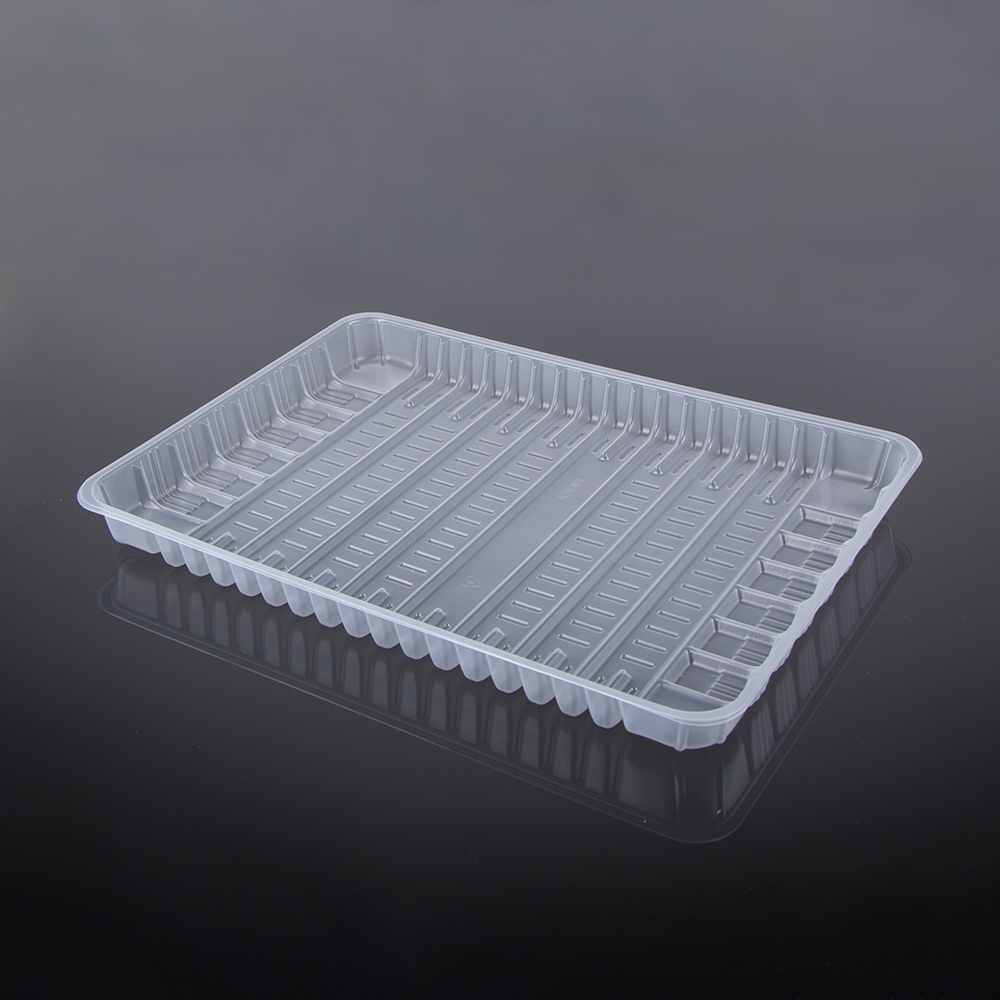
Verify Regulatory Compliance for Plastic Meat Trays
FDA 21 CFR Part 177 Requirements for Meat Contact Applications
For plastic meat trays intended for direct contact with fresh meat, the resin and all additives must comply with FDA 21 CFR Part 177. This regulation specifies permissible polymer substances, temperature limits, fatty food simulants (e.g., olive oil), and overall migration thresholds—critical because high-fat and acidic meats accelerate chemical transfer. Suppliers must provide a written FDA compliance letter confirming the material is approved for the specific meat application—not just generic food contact. Crucially, documentation must cover the entire tray structure, not just surface layers, and testing must reflect worst-case conditions: extended refrigerated storage, high-fat content (≥20%), and acidic pH (e.g., lactic acid). Without evidence that monomers, catalysts, or processing aids remain below regulatory limits, trays risk compromising meat safety. Maintaining batch-specific test reports and compliance letters ensures readiness for FDA inspections and strengthens supply chain accountability.
EU Regulation (EC) No 1935/2004 and LFGB Testing: What Importers Must Confirm
Importers targeting the European market must verify that every plastic meat tray meets the EU’s Framework Regulation (EC) No 1935/2004, which mandates that materials do not migrate constituents in quantities harmful to health or detrimental to sensory quality or composition of meat. While this is the foundational requirement, many major retailers—and particularly German buyers—also require compliance with the more stringent LFGB standard, which includes mandatory sensory testing and tighter migration limits for plasticizers and primary aromatic amines. You must obtain a Declaration of Compliance (DoC) tied directly to validated test reports, clearly identifying the material, its formulation, and its intended use conditions (e.g., short-term refrigerated contact with fatty, acidic meat). The DoC must explicitly confirm testing against relevant simulants—such as 3% acetic acid for acidity and olive oil for fat—since omission here invalidates compliance for meat applications. Failure to secure this documentation risks customs detention, costly recalls, or loss of retail shelf space. Pre-shipment verification—not post-arrival—is the only reliable safeguard.
Compare Plastic Materials for Fresh Meat Trays: PP, PET, and HDPE
Barrier Performance Against Fat, Moisture, and Acidic Juices
The barrier performance of a plastic meat tray governs shelf life and safety by controlling interactions with meat exudates—especially fat, moisture, and organic acids like lactic acid. Among the three most widely used materials—PP (Polypropylene), PET (Polyethylene Terephthalate), and HDPE (High-Density Polyethylene)—barrier properties differ significantly:
| Material | Fat Resistance | Moisture Barrier | Acid Resistance | Overall Suitability for Fresh Meat |
|---|---|---|---|---|
| PP | Excellent — does not swell or degrade in contact with fatty tissues | Moderate — permits some moisture loss but protects against external humidity | High — inert to lactic acid and other organic acids from meat | Best for fatty cuts and long-term display; maintains structural integrity |
| PET | Good — clear and resistant to lipid absorption | Good — strong barrier against moisture ingress | Good — stable in acidic environments, but susceptible to hydrolysis and stress cracking under prolonged low-pH exposure | Ideal for premium presentation where clarity is prioritized |
| HDPE | Good — resists fat penetration but can be less rigid | Excellent — very low water vapor transmission rate | Good — resistant to most acids, though vulnerable to strong oxidizing agents in marinades | Well-suited for moisture-rich products like fresh poultry, though less clear |
A 2022 study by the Institute of Packaging Professionals found PP reduced visible drip loss by 12% compared to PET when holding ground beef with 20% fat—attributed to PP’s non-polar surface repelling lipids and preventing surface degradation. In contrast, PET’s ester bonds slowly hydrolyze below pH 4.5, while PP remains chemically inert. HDPE offers superior moisture control but often lacks the rigidity needed for stacking heavy cuts, increasing risk of deformation and seal failure. Material selection, therefore, hinges on aligning chemical resistance and mechanical performance with the specific product profile and display environment.
Case Insight: How Switching from PET to PP Plastic Meat Trays Extended Shelf Life by 1.5 Days
A mid-sized European meat processor observed consistent early spoilage—purge accumulation and off-odors—by day 7 in premium beef steaks packaged in clear PET trays, despite high-quality overwrap. In 2023, they conducted a controlled trial switching part of production to PP trays selected for their superior fat resistance and lower moisture absorption—properties previously validated by the International Meat Packaging Association (2023) to reduce purge by 18%.
Results were immediate: average refrigerated shelf life increased from 7.0 to 8.5 days. PP trays maintained dimensional stability, eliminating micro-leaks that had allowed oxygen ingress and accelerated myoglobin oxidation—preserving brighter red color longer. Within the first quarter of adoption, the processor reported a 9% reduction in retail markdowns due to spoilage. This case confirms that material substitution—particularly moving from PET to PP for high-fat items—delivers measurable gains in shelf life, visual appeal, and profitability when the tray’s chemical resistance matches the product’s inherent chemistry.
Mitigate Chemical Migration Risks in Plastic Meat Tray Usage
BPA-Free Certification and Plasticizer Limits for High-Fat Fresh Meat
High-fat fresh meat acts as an aggressive extraction medium, significantly accelerating migration of lipophilic substances—including plasticizers like di(2-ethylhexyl) phthalate (DEHP). When fat content exceeds 20%, DEHP migration can rise sharply: a 2022 European reference laboratory study found levels of 2.1 mg/kg in minced pork stored in non-compliant trays—exceeding the EU Regulation 10/2011 limit of 1.5 mg/kg. To mitigate this, importers must require BPA-free certification—even for inherently BPA-free resins like PP, PET, and HDPE—to rule out cross-contamination from recycled feedstocks or coatings. Equally essential is third-party validation of ortho-phthalate limits (DBP, BBP, DEHP) and other endocrine-disrupting additives. Leading suppliers now offer certified formulations with residual phthalate migration consistently below 0.3 mg/kg in fatty food simulants—meeting both FDA 21 CFR and EU regulatory benchmarks. Pairing these certifications with batch-specific test reports enables buyers to uphold food safety, regulatory compliance, and brand integrity across high-fat meat applications.
FAQs
How do I verify FDA compliance for plastic meat trays?
You need a written FDA compliance letter from your supplier confirming the material is approved for meat applications. Ensure the documentation covers the entire tray structure and testing reflects worst-case conditions.
Do European regulations differ from FDA requirements?
Yes, European regulations, including EU Regulation (EC) No 1935/2004 and LFGB standards, focus on strict migration limits, sensory quality, and Declaration of Compliance (DoC) documentation clearly identifying intended use.
Which plastic material is best for fresh meat trays?
Polypropylene (PP) offers the best overall performance for high-fat meats, while PET excels in clarity and HDPE provides excellent moisture control. Select materials based on meat type and shelf-life needs.
What certifications are necessary for mitigating chemical migration risks?
BPA-free certification and validation of plasticizer limits (e.g., DEHP) are crucial for high-fat applications. Batch-specific test reports ensure compliance with FDA 21 CFR and EU standards.