
 EN
EN
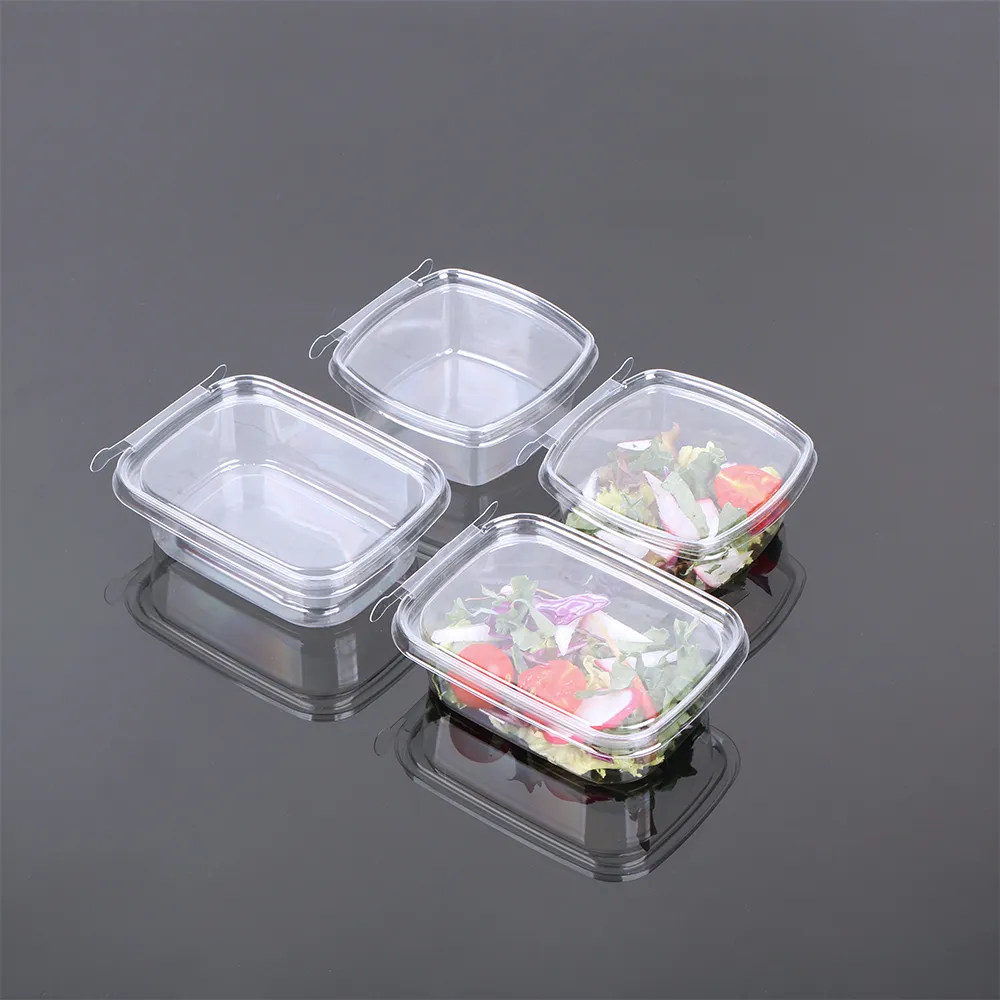
What Makes PET Clamshell Transparent? Molecular Structure and Optical Science
Amorphous PET vs. Crystalline Regions: Why Uniformity Drives Clarity
PET (polyethylene terephthalate) derives its transparency from the arrangement of its polymer chains—repeating units of ethylene glycol and terephthalic acid. In its amorphous state, these chains are randomly coiled, creating uniform optical density and minimal light scattering. This isotropy yields the glass-like clarity characteristic of high-performance PET clamshells. In contrast, slow cooling encourages crystallization: polymer chains fold into ordered lattices that differ in refractive index from the amorphous matrix, deflecting light and introducing haze. Rapid cooling during thermoforming suppresses crystal growth, locking in the amorphous structure. When properly processed, PET transmits ~92% of visible light and retains ~98% of its initial clarity after 24 hours refrigeration—demonstrating how structural uniformity underpins optical performance.
Key Optical Metrics: Haze, Yellowness Index, and Gloss for PET Clamshell Evaluation
Transparency is quantified using three standardized metrics. Haze, measured per ASTM D1003, reports the percentage of transmitted light scattered by more than 2.5°—a direct indicator of internal or surface imperfections. Premium PET clamshells target haze below 3–5%. Yellowness Index (YI), calculated from CIE tristimulus values, detects thermal or oxidative degradation; food-grade packaging aims for YI < 1.0 to preserve neutral appearance. Gloss, assessed at 60° per ASTM D523, reflects surface smoothness and specular reflectance—values above 100 GU enhance perceived brightness and freshness. These parameters are interdependent: low haze and YI combined with high gloss signal a consistently clear, premium product optimized for high-speed filling lines and consumer appeal.
Critical Selection Criteria for High-Transparency PET Clamshell
Clarity Requirements vs. FDA/EFSA Compliance and Mechanical Rigidity
Achieving high transparency requires balancing optics with regulatory safety and mechanical integrity. While PET’s natural amorphous structure supports haze < 2%, clarity-enhancing additives must comply with FDA 21 CFR 177.1630 and EFSA Regulation (EU) No 10/2011—restricting nucleating agents or clarifiers that could compromise food-contact safety. Simultaneously, rigidity cannot be compromised: a functional clamshell must withstand stacking loads and drop impacts without cracking. Smithers’ 2022 study found that sub-3% haze increases purchase intent by 25%, yet tensile strength must remain ≥55 MPa to survive distribution. The optimal resin grade delivers amorphous uniformity while meeting extractable migration limits—and process controls must ensure rapid cooling preserves both clarity and toughness. Any masterbatch or processing aid must be validated for compliance and mechanical reliability, making integrated material selection and testing essential.
Dimensional Stability and Thermoforming Consistency for High-Speed Filling Lines
On automated lines, dimensional stability is as vital as optical clarity. A deviation of just 0.3 mm can trigger misfeeds, seal misalignment, or line stoppages—costing an average of $4,500/hour in downtime (PMMI, 2023). PET’s low moisture absorption (<0.1% at 23°C/50% RH) gives it an advantage over alternatives like PLA, but thermal stresses during thermoforming may still cause post-mold shrinkage. To ensure consistency, mold temperature must be controlled within ±2°C, and rapid, uniform cooling must freeze the amorphous orientation. Target outcomes include wall thickness variation <5% and flatness suitable for vacuum-assisted denesting. When achieved, these conditions support line speeds >120 packs/minute with zero jams or rejects—proving that optical excellence and operational reliability go hand-in-hand.
Processing Best Practices to Maintain PET Clamshell Transparency
Drying, Moisture Control (<50 ppm), and Rapid Cooling for Amorphous Clarity
Moisture control is foundational: PET resin must be dried to <50 ppm water content prior to extrusion. Residual moisture causes hydrolysis at melt temperatures (~280°C), cleaving polymer chains and generating microbubbles and haze. Once molten, the PET must be rapidly quenched—typically to <70°C—to prevent crystallite formation. Cooling rates exceeding 100°C/s, achieved via chilled water or forced-air systems, effectively “freeze” the amorphous structure, preserving the molecular uniformity required for glass-like transparency.
Mold Temperature and Orientation Management During Thermoforming
Mold temperature critically influences final clarity. Keeping surfaces between 10°C and 30°C prevents premature crystallization that leads to milky discoloration. Equally important is balanced biaxial orientation during forming—ideally stretching 2.5–3.5× in both directions. This aligns polymer chains uniformly without inducing stress-induced crystallinity, which would elevate haze. Proper orientation also enhances mechanical strength while maintaining optical fidelity—ensuring the clamshell remains both strong and stunningly clear.
Why High-Transparency PET Clamshell Is the Optimal Choice Over Alternatives
High-transparency PET clamshell packaging delivers a unique convergence of visual appeal, functional performance, and sustainability—outperforming common alternatives. Its amorphous structure provides unmatched clarity, enabling consumers to instantly assess product freshness—a decisive advantage over semi-crystalline polypropylene (PP), which inherently scatters light. Though PP offers higher heat resistance, it sacrifices the optical brilliance that drives impulse purchases in retail. PVC delivers strength but faces growing recycling barriers and environmental scrutiny, limiting long-term viability. Biodegradable options like PLA often lack consistent clarity and moisture barrier performance for fresh food applications. By contrast, PET’s widespread municipal recyclability (resin code #1), compatibility with post-consumer recycled (PCR) content, and ability to maintain transparency at scale support circular economy goals. Combined with robust impact resistance, moderate thermal tolerance, and competitive cost-per-unit, high-transparency PET offers the optimal balance of shelf impact, protection, and responsible sourcing—for brands committed to both consumer experience and environmental stewardship.
FAQ
What is PET clamshell transparency and how is it achieved?
PET clamshell transparency refers to the ability of PET (polyethylene terephthalate) packaging to allow light to pass through with minimal scattering or distortion. It is achieved through its amorphous molecular structure created during rapid cooling processes, which suppresses crystallization.
What are the key metrics used to evaluate PET clamshell transparency?
The transparency of PET clamshells is evaluated using metrics like Haze (percent of light scattered), Yellowness Index (indication of degradation), and Gloss (reflectance), ensuring low haze for clarity and high gloss for visual appeal.
How does moisture control impact PET transparency?
Controlling moisture below 50 ppm during processing prevents hydrolysis at high temperatures, which can lead to chain cleavage, microbubbles, and reduced transparency.
What makes PET clamshells better than alternatives like PP, PVC, or PLA?
PET clamshells offer superior clarity, recyclability, functional performance, and moderate cost, making them a more sustainable and visually appealing option over semi-crystalline PP, environmentally scrutinized PVC, or less consistent PLA.
Why is dimensional stability important for PET clamshells?
Dimensional stability ensures PET clamshells maintain consistent shape during high-speed filling processes, reducing line stoppages, seal misalignment, or rejects due to deviations.
Table of Contents
- What Makes PET Clamshell Transparent? Molecular Structure and Optical Science
- Critical Selection Criteria for High-Transparency PET Clamshell
- Processing Best Practices to Maintain PET Clamshell Transparency
- Why High-Transparency PET Clamshell Is the Optimal Choice Over Alternatives
-
FAQ
- What is PET clamshell transparency and how is it achieved?
- What are the key metrics used to evaluate PET clamshell transparency?
- How does moisture control impact PET transparency?
- What makes PET clamshells better than alternatives like PP, PVC, or PLA?
- Why is dimensional stability important for PET clamshells?